 BuddhaUR
Stories from the Suttas · Story 02
The Tortoise and the Jackal
SN 35.240, The Simile of the Tortoise, tr. Bhikkhu Sujato
The footage in this reel was generated, not filmed, and the narration is a synthetic voice.
In the sutta's words
“Once upon a time, mendicants, a tortoise was grazing along the bank of a river in the afternoon. At the same time, a jackal was also hunting along the river bank. The tortoise saw the jackal off in the distance hunting, so it drew its limbs and neck inside its shell, and kept passive and silent.”
sn35.240:1.1–1.4, Bhikkhu Sujato's translation.
“But the jackal also saw the tortoise off in the distance grazing. So it went up to the tortoise and waited nearby, thinking, ‘When that tortoise sticks one or other of its limbs or neck out from its shell, I’ll grab it right there, rip it out, and eat it!’ But when that tortoise didn’t stick one or other of its limbs or neck out from its shell, the jackal left disappointed, since it couldn’t find a vulnerability.”
sn35.240:1.5–1.8, Bhikkhu Sujato's translation.
“In the same way, Māra the Wicked is always waiting nearby, thinking: ‘Hopefully I can find a vulnerability in the eye, ear, nose, tongue, body, or mind.’ That’s why you should live with sense doors guarded. When you see a sight with your eyes, don’t get caught up in the features and details.”
sn35.240:2.1–2.6, Bhikkhu Sujato's translation.
“When you live with your sense doors guarded, Māra will leave you disappointed, since he can’t find a vulnerability, just like the jackal left the tortoise.”
sn35.240:2.14–2.15, Bhikkhu Sujato's translation.
The tortoise sees the jackal while it is still far off and draws in its limbs and neck before the jackal comes up to it (1.3–1.6). The jackal waits for a limb or the neck to come out (1.6–1.7) and leaves when none does (1.8). Māra is the comparison, not a character in the story (2.1). Guarding the sense doors is not shutting out the world. The sutta speaks of seeing a sight, hearing a sound, smelling an odor, tasting a flavor, feeling a touch and knowing an idea. It spells out “don’t get caught up in the features and details” for seeing a sight (2.6) and knowing an idea (2.12); the lines for hearing, smelling, tasting and feeling end in an ellipsis (2.8–2.11). Left unrestrained, a faculty lets covetousness and displeasure become overwhelming, so the sutta asks for restraint, protecting the faculty (2.7, 2.13).
The discourse closes in verse: “A mendicant should collect their thoughts as a tortoise draws its limbs into its shell. Independent, not disturbing others, quenched: they wouldn’t blame anyone.” (sn35.240:3.1–3.4)
Next in Stories from the Suttas
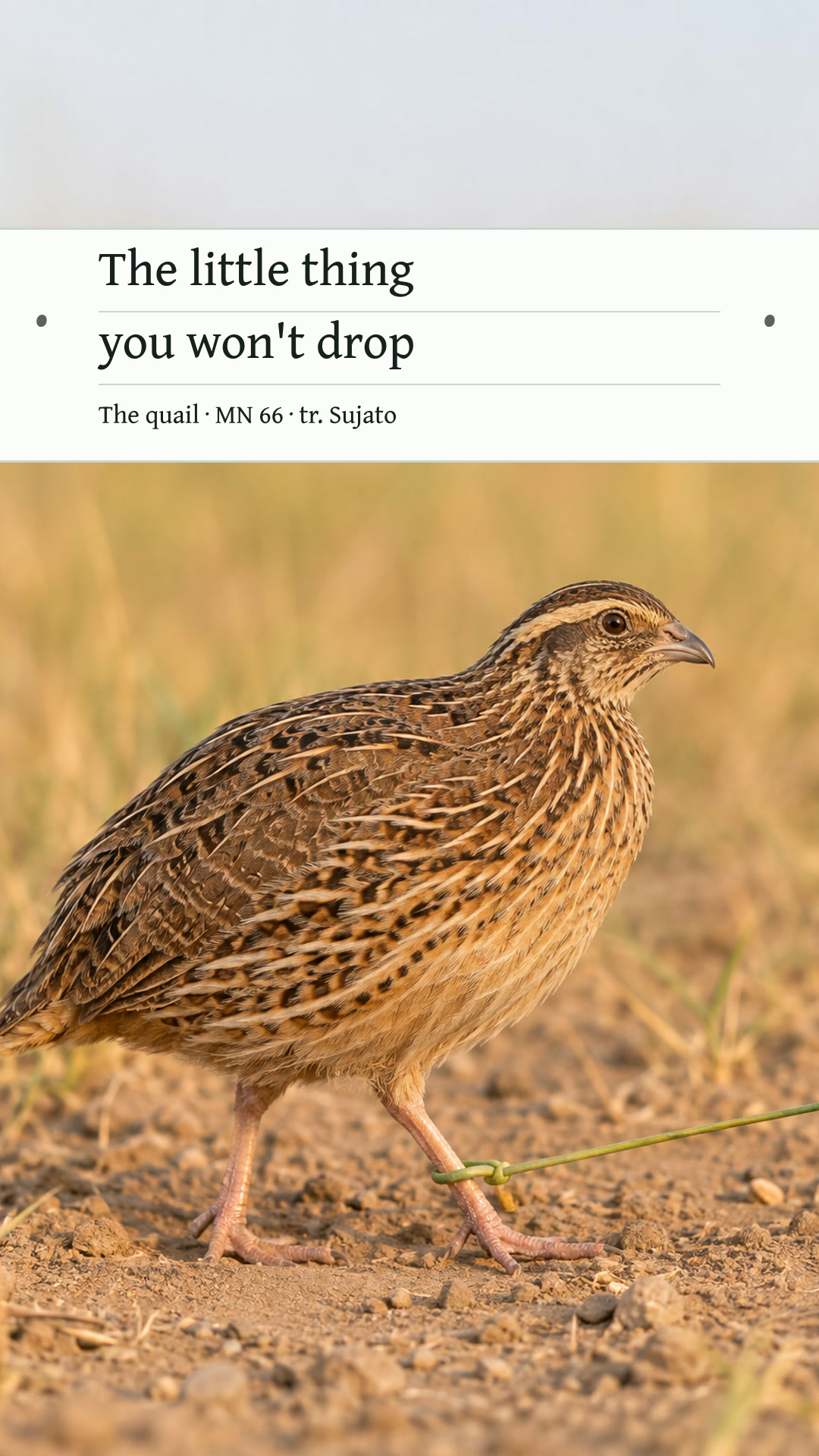 Story 03The Quail and the ElephantMN 66
Also in this series: The Monkey and the Tar · The Dog and the Bones · The King and the Harp
Go further in BuddhaUR
Ask about the tortoise and the jackal in SN 35.240, with no account needed.